
 One of the biggest mistakes people make with direct mail is thinking they need to send hundreds or thousands of letters at one time.
You don’t.
In fact, one of the simplest ways to build a direct mail business is to start with a small number you can comfortably afford and mail consistently.
This is based on the Turtle Mailing Method I developed.
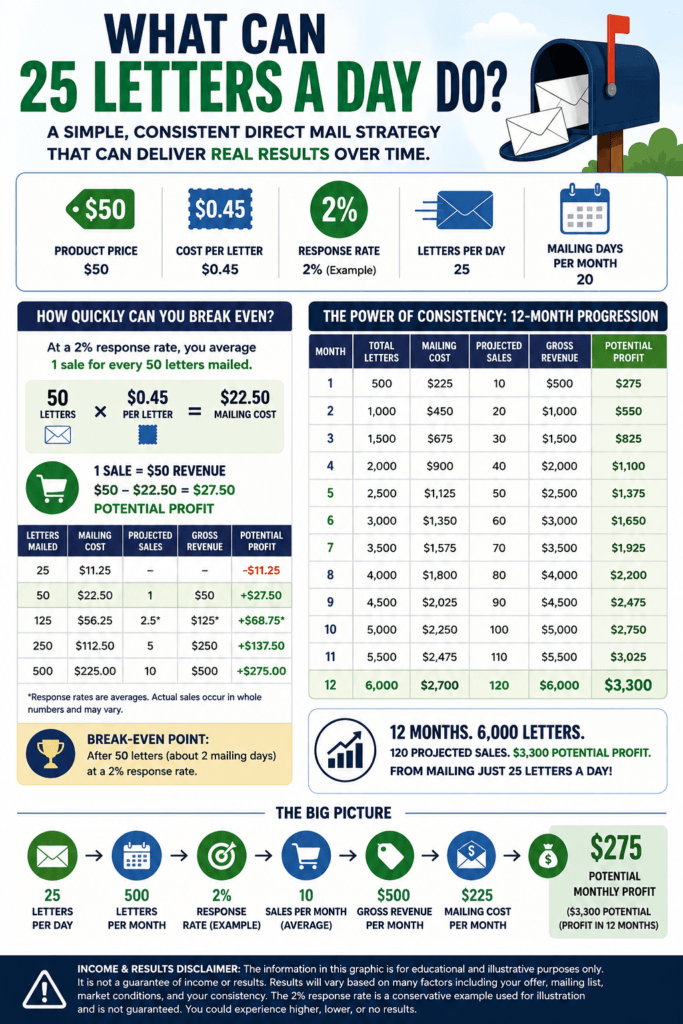
Let’s look at a simple example of mailing just 25 letters per day while promoting a product that sells for $50.
Our Example
For this example, we’ll use the following numbers:
-
Product Price: $50
-
Cost Per Letter: $0.45
-
Example Response Rate: 2%
-
Letters Mailed Per Day: 25
-
Mailing Days Per Month: 20
NOTE: I am using the discount postage rate of .20 cents per stamp if you purchase them from our discount vendor included in the resource section of the training on the members page. The remaining .25 is the cost of the lead, paper, envelope and printing. I have tracked these costs and this a bit higher than my current costs. If you use retail postage currently at .82 cents you will need to change accordingly.
That means you’re mailing approximately 500 letters per month.
Your daily mailing cost would be:
25 Letters × $0.45 = $11.25 Per Day
That’s the beauty of approaching direct mail this way.
Instead of trying to come up with hundreds of dollars for one huge mailing, you’re building your mailing campaign one small batch at a time.
What Does a 2% Response Rate Look Like?
A 2% response rate means that, statistically, you would average approximately:
1 Sale for Every 50 Letters Mailed
If your product sells for $50:
50 letters × $0.45 = $22.50 mailing cost
One $50 sale would produce:
$50.00 Gross Revenue
Minus:
$22.50 Mailing Cost
Leaving:
$27.50 Potential Profit
Of course, real-world sales don’t arrive on a perfectly predictable schedule.
You might mail 100 letters without receiving an order and then receive several orders close together. That’s why it’s important to evaluate direct mail results over a larger sample rather than judging the success or failure of a campaign based on a handful of letters.
How Quickly Could You Reach the Break-Even Point?
Using our hypothetical 2% response rate, here’s what the progression looks like:
| Letters Mailed | Mailing Cost | Projected Sales | Gross Revenue | Potential Profit |
|---|---|---|---|---|
| 25 | $11.25 | — | — | -$11.25 |
| 50 | $22.50 | 1 | $50 | +$27.50 |
| 125 | $56.25 | 2.5* | $125* | +$68.75* |
| 250 | $112.50 | 5 | $250 | +$137.50 |
| 500 | $225.00 | 10 | $500 | +$275.00 |
Response rates represent statistical averages. Actual sales occur in whole numbers and may be higher, lower, earlier, later, or nonexistent.
Under these assumptions, the campaign would statistically move into profitability after approximately 50 letters.
At 25 letters per day, that’s only two mailing days.
Again, that doesn’t mean you’re guaranteed to receive an order on Day 2. It simply demonstrates the mathematics behind a 2% average response rate.
The Power of Consistency
This is where the example gets interesting.
Instead of asking:
“How much money can I make from today’s 25 letters?”
Ask:
“What happens if I keep mailing 25 letters every day?”
Twenty-five letters doesn’t sound like much.
But 25 letters × 20 mailing days equals:
500 Letters Per Month
Keep doing it for an entire year and you’ve mailed:
6,000 Letters!
Now let’s apply the same hypothetical 2% response rate.
Your 12-Month Progression
| Month | Total Letters | Mailing Cost | Projected Sales | Gross Revenue | Potential Profit |
|---|---|---|---|---|---|
| 1 | 500 | $225 | 10 | $500 | $275 |
| 2 | 1,000 | $450 | 20 | $1,000 | $550 |
| 3 | 1,500 | $675 | 30 | $1,500 | $825 |
| 4 | 2,000 | $900 | 40 | $2,000 | $1,100 |
| 5 | 2,500 | $1,125 | 50 | $2,500 | $1,375 |
| 6 | 3,000 | $1,350 | 60 | $3,000 | $1,650 |
| 7 | 3,500 | $1,575 | 70 | $3,500 | $1,925 |
| 8 | 4,000 | $1,800 | 80 | $4,000 | $2,200 |
| 9 | 4,500 | $2,025 | 90 | $4,500 | $2,475 |
| 10 | 5,000 | $2,250 | 100 | $5,000 | $2,750 |
| 11 | 5,500 | $2,475 | 110 | $5,500 | $3,025 |
| 12 | 6,000 | $2,700 | 120 | $6,000 | $3,300 |
Here’s the Entire Example in One Picture:
25 Letters Per Day
↓
500 Letters Per Month
↓
6,000 Letters Per Year
↓
2% Example Response Rate
↓
120 Projected Sales
↓
$6,000 Gross Revenue
↓
$2,700 Mailing Costs
↓
$3,300 Potential Profit
And remember, this example assumes you’re only selling a $50 product.
It does not include any additional products, repeat purchases, back-end offers, upsells, or other potential revenue from the customers you acquire.
What If I Can Only Afford 20 Letters Per Day?
That’s perfectly fine.
The lesson here isn’t that you have to mail exactly 25 letters.
The lesson is consistency.
At 20 letters per mailing day:
20 letters × 20 days = 400 letters per month
Using the same hypothetical 2% response rate:
400 letters × 2% = 8 projected sales
8 sales × $50 = $400 gross revenue
Mailing cost:
400 × $0.45 = $180
That leaves:
$220 Potential Monthly Profit
Continue that pace for 12 months and you would mail approximately 4,800 letters.
Using the same assumptions, that would produce:
-
96 projected sales
-
$4,800 gross revenue
-
$2,160 mailing costs
-
$2,640 potential profit
Again, these are projections—not guaranteed results.
Small Numbers Add Up!
This is one of the most important lessons in direct mail.
You don’t necessarily need to start big.
You need to start and stay consistent.
Mail 20 today.
Mail another 20 tomorrow.
Or set your goal at 25.
Maybe eventually you increase it to 50.
The exact number isn’t nearly as important as developing the discipline to keep your mail moving every week.
A small mailing that actually gets sent is infinitely more valuable than 1,000 letters sitting on your desk waiting for the “perfect time” to mail them.
Don’t Judge Your Mailing Too Quickly
Direct mail is a numbers game, and small samples can be misleading.
If you mail 25 letters and don’t receive an order, that doesn’t necessarily tell you anything.
Even 50 letters is a very small sample.
That’s why tracking your results over hundreds of pieces gives you a much better picture of how your mailing is actually performing.
Track:
-
How many letters you mail
-
Your total mailing costs
-
How many responses you receive
-
How many sales you make
-
Your revenue
-
Your actual response rate
-
Your profit or loss
Then use your own numbers to make smarter decisions about future mailings.
Now Let’s Add a $200 Back-End Offer
So far, we’ve only looked at the potential income from selling our original $50 front-end product.
But what happens when some of those customers are offered a higher-value product?
Let’s assume that after purchasing the $50 product, each customer is introduced to a $200 back-end product.
For this example, we’ll assume that 15% of your front-end customers eventually purchase the $200 back-end offer.
This is where the numbers can become much more interesting.
Our Back-End Example
Using the same assumptions from our original mailing:
-
25 letters mailed per day
-
500 letters mailed per month
-
$0.45 cost per letter
-
2% front-end response rate
-
$50 front-end product
-
10 projected front-end sales per month
-
$200 back-end product
-
15% projected back-end conversion rate
At 10 new front-end customers per month, a 15% back-end conversion rate averages:
1.5 Back-End Sales Per Month
Since you can’t actually make half a sale, don’t expect exactly 1.5 sales every month.
You might make one back-end sale one month, two the next, and none during another month. The 15% figure is an average used to illustrate what could happen over a larger number of customers.
Over 12 months, however, our original example produces 120 projected front-end customers.
At a 15% back-end conversion rate:
120 Customers × 15% = 18 Back-End Sales
At $200 per sale:
18 × $200 = $3,600 in Additional Back-End Revenue
Now let’s combine that with our original $50 product.
12-Month Front-End + Back-End Progression
| Month | Letters Mailed | $50 Front-End Sales | Front-End Revenue | Projected $200 Back-End Sales* | Back-End Revenue* | Total Revenue* | Mailing Cost | Potential Profit* |
|---|---|---|---|---|---|---|---|---|
| 1 | 500 | 10 | $500 | 1.5 | $300 | $800 | $225 | $575 |
| 2 | 1,000 | 20 | $1,000 | 3 | $600 | $1,600 | $450 | $1,150 |
| 3 | 1,500 | 30 | $1,500 | 4.5 | $900 | $2,400 | $675 | $1,725 |
| 4 | 2,000 | 40 | $2,000 | 6 | $1,200 | $3,200 | $900 | $2,300 |
| 5 | 2,500 | 50 | $2,500 | 7.5 | $1,500 | $4,000 | $1,125 | $2,875 |
| 6 | 3,000 | 60 | $3,000 | 9 | $1,800 | $4,800 | $1,350 | $3,450 |
| 7 | 3,500 | 70 | $3,500 | 10.5 | $2,100 | $5,600 | $1,575 | $4,025 |
| 8 | 4,000 | 80 | $4,000 | 12 | $2,400 | $6,400 | $1,800 | $4,600 |
| 9 | 4,500 | 90 | $4,500 | 13.5 | $2,700 | $7,200 | $2,025 | $5,175 |
| 10 | 5,000 | 100 | $5,000 | 15 | $3,000 | $8,000 | $2,250 | $5,750 |
| 11 | 5,500 | 110 | $5,500 | 16.5 | $3,300 | $8,800 | $2,475 | $6,325 |
| 12 | 6,000 | 120 | $6,000 | 18 | $3,600 | $9,600 | $2,700 | $6,900 |
Back-end sales are statistical projections. Actual sales occur in whole numbers and will vary.
Look at the Difference
With no back-end product, our original 12-month example looked like this:
6,000 Letters Mailed
↓
120 Projected $50 Sales
↓
$6,000 Gross Revenue
↓
$2,700 Mailing Costs
↓
$3,300 Potential Profit
Now add a $200 back-end product purchased by an average of 15% of those customers:
6,000 Letters Mailed
↓
120 Projected $50 Front-End Sales
↓
$6,000 Front-End Revenue
↓
18 Projected $200 Back-End Sales
↓
$3,600 Additional Back-End Revenue
↓
$9,600 Total Projected Revenue
Minus the original $2,700 mailing cost:
$6,900 Potential Profit
That’s more than double the potential profit from exactly the same 6,000 letters.
Why the Back-End Can Be So Powerful
This illustrates an important direct-mail principle:
The first sale doesn’t necessarily have to be the most profitable sale.
The $50 product can serve another important purpose—it helps you identify buyers.
Instead of continually spending money trying to sell something to strangers, every front-end sale gives you a customer who has already demonstrated that they are willing to spend money with you.
That customer can potentially be worth much more than the original $50 purchase.
In our example, each 100 front-end customers would statistically produce:
100 × 15% = 15 Back-End Customers
Those 15 customers purchasing a $200 product would generate:
$3,000 in Additional Revenue
And you didn’t have to acquire 15 new customers from scratch.
They came from the customers you had already acquired through your original mailing.
The Real Lesson: Think Beyond the First Sale
This is why it’s important not to evaluate a mailing campaign based solely on the initial sale.
Your first $50 sale may only be the beginning of that customer’s value to your business.
Using our hypothetical numbers, after 12 months:
6,000 Letters Mailed
$2,700 Total Mailing Investment
– 120 Projected Front-End Sales
$6,000 Front-End Revenue
– 18 Projected Back-End Sales
$3,600 Additional Revenue
– $9,600 Combined Projected Revenue
$6,900 Potential Profit
All from the simple habit of mailing approximately:
25 Letters a Day.
The goal isn’t necessarily to mail huge quantities all at once.
The goal is to create a simple process you can afford, stay consistent, track your results, build a customer list, and maximize the long-term value of the customers you acquire.
The Bottom Line
You don’t need to mail 1,000 letters tomorrow.
Start with a number that fits your budget.
If that’s 20 letters per day, mail 20.
If it’s 25, mail 25.
The important thing is to develop a mailing schedule you can maintain.
Start Small. Track Your Results. Stay Consistent. Keep Mailing.
That’s how 25 little envelopes going into the mailbox today can eventually turn into thousands of opportunities to put your offer in front of potential customers.
Important Income & Results Disclaimer
All figures in this example are hypothetical and provided solely for educational and illustrative purposes. They are not a guarantee or representation of actual income, sales, response rates, conversion rates, or profits.
The 2% front-end response rate and 15% back-end conversion rate are example assumptions intended to illustrate the mathematics of a direct-mail campaign using realistic, conservative hypothetical numbers. Actual results can vary significantly and may be higher or lower.
Results depend on numerous factors, including the mailing list, offer, product, pricing, sales materials, follow-up, market conditions, mailing consistency, customer demand, individual effort, and other variables. Always track your own results before increasing your mailing volume or investment.